
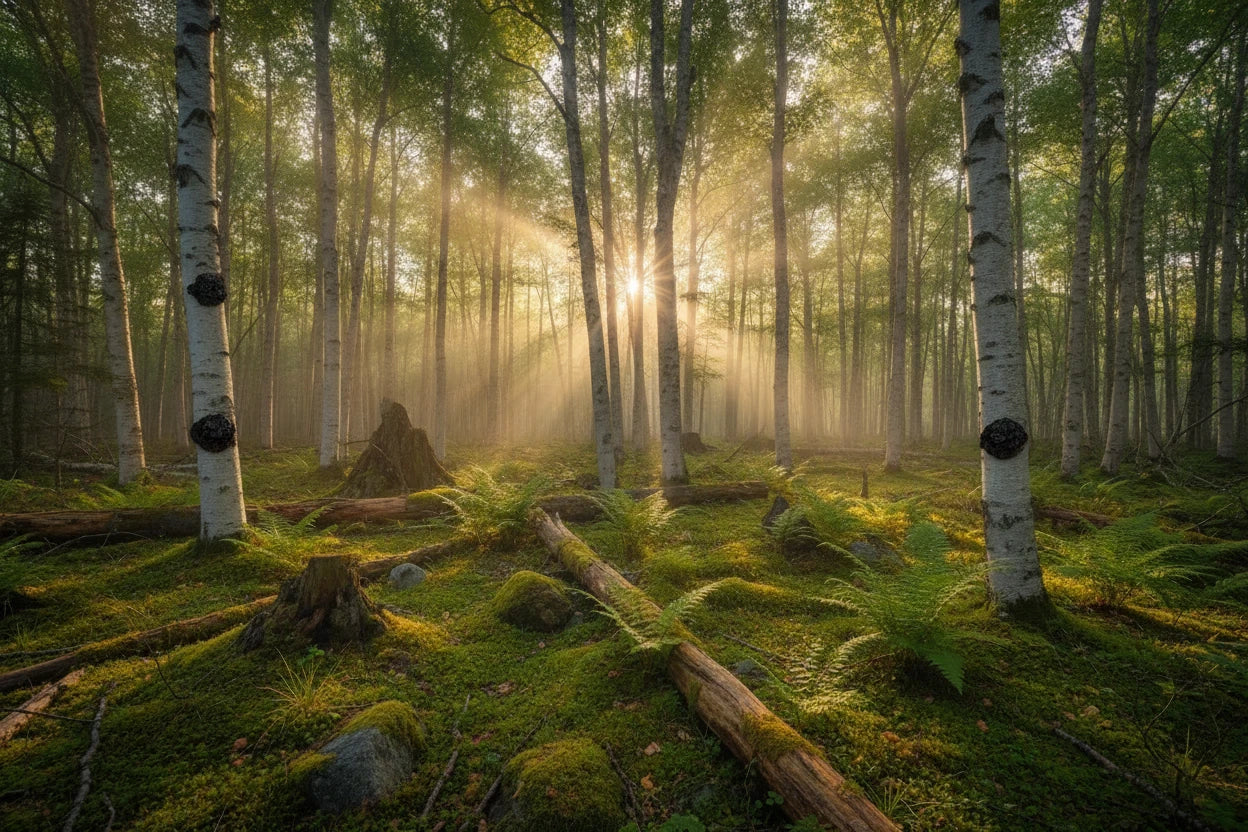
Chaga (Inonotus obliquus) is one of the most misunderstood fungi in the northern forest. Its unusual appearance, slow growth, and long history of traditional use have led to decades of confusion about what chaga actually is, how it grows, and how it differs from other mushrooms.
This guide explores some of the most common myths and misunderstandings surrounding chaga while highlighting the ecological and biological facts that matter most.
Myth #1: Chaga Is a Typical Mushroom
One of the most common misconceptions is that chaga is simply another mushroom.
While chaga is a fungus, it does not resemble the familiar cap-and-stem mushrooms most people picture when they think of fungi. Instead, chaga forms as a dense, charcoal-black mass on living birch trees.
What people commonly call "chaga" is actually a sterile conk rather than a typical mushroom fruiting body.
Learn more in our guide to What Is Chaga Mushroom?
Myth #2: The Black Conk Is the Fruiting Body
The dark growth harvested from birch trees is often mistaken for the reproductive structure of the fungus.
In reality, the visible chaga conk is not the fruiting body.
The true fruiting body of Inonotus obliquus develops only after the host tree dies and is rarely observed in the wild. Because this stage occurs beneath the bark and for a relatively short period of time, many people never encounter it.
Learn more in:
Myth #3: Chaga Grows Like Other Forest Mushrooms
Many mushrooms emerge seasonally, release spores, and disappear within weeks.
Chaga follows a very different lifecycle.
It develops slowly over many years on living birch trees in cold northern forests. This gradual process contributes to its distinctive appearance and explains why mature chaga is much less common than many other mushroom species.
Myth #4: Chaga Is Just a Black Growth on a Tree
At a distance, chaga can resemble burnt wood, black knot, or other tree abnormalities.
However, true chaga has several recognizable characteristics:
- A dark, cracked exterior
- A rust-orange interior
- A strong association with living birch trees
- An irregular, charcoal-like appearance
Understanding these features is essential for proper identification.
Learn more in our Chaga Identification Guide.
Myth #5: All Chaga Is the Same
Environmental conditions play an important role in how chaga develops.
Geography, climate, host tree species, forest conditions, and harvesting practices can all influence the characteristics of wild chaga.
This is one reason why sourcing and forest stewardship remain important topics within the chaga community.
Learn more:
Myth #6: Chaga Has Always Been Understood Correctly
Because of its hidden reproductive stage and unusual lifecycle, chaga's biology was misunderstood for decades.
Researchers, harvesters, and naturalists have gradually improved our understanding of Inonotus obliquus, helping separate folklore, assumptions, and speculation from observable fungal biology.
Today, responsible education focuses on what chaga is, where it grows, how it develops, and how it has traditionally been prepared.
What Chaga Is Not
To be clear:
- Chaga is not a typical mushroom.
- Chaga is not the fungus's fruiting body.
- Chaga is not a fast-growing forest product.
- Chaga is not interchangeable with every mushroom species.
- Chaga is not best understood through hype or exaggerated claims.
Instead, chaga is best understood as a unique birch-associated fungus that has developed a long history of traditional use and cultural significance in northern forest regions.
What Actually Matters
When learning about chaga, the most useful questions are often:
- What is chaga?
- Where does chaga grow?
- How can it be identified?
- How is it traditionally prepared?
- What makes chaga different from other fungi?
Understanding these fundamentals helps separate myth from reality and provides a stronger foundation for exploring chaga responsibly.

